RELATIONSHIPS IN A DIGITAL DISCONNECTED WORLD
Safeguarding professionals are increasingly expected, including through Ofsted inspections, to understand risk beyond the school gate. But young people’s lives don’t sit in one place. They move constantly between home, school, community and digital spaces, and these connections are not always visible to adults. With growing complexity around exploitation, online harm and peer relationships, schools are being asked to make sense of risk across multiple contexts, often without full visibility of what young people are experiencing.
Insight-led Webinar
For DSLs and safeguarding professionals
RELATIONSHIPS IN A DIGITAL DISCONNECTED WORLD
Safeguarding professionals are increasingly expected, including through Ofsted inspections, to understand risk beyond the school gate. But young people’s lives don’t sit in one place. They move constantly between home, school, community and digital spaces, and these connections are not always visible to adults. With growing complexity around exploitation, online harm and peer relationships, schools are being asked to make sense of risk across multiple contexts, often without full visibility of what young people are experiencing.
Insight-led Webinar
Monday 15th June 2026 3.30pm
For DSLs and safeguarding professionals
Are you managing the complex, real-world risks young people face in their communities?
This webinar brings together data, frontline insight and youth voice to explore how young people’s experiences connect across home, school, community and digital environments. It highlights how risk can develop across these contexts, and what this means for how safeguarding concerns are identified and understood. This is not about adding more processes. It’s about improving how we see, understand and respond to the realities young people face every day.
What is this webinar about? Hear from your hosts.
Meet your hosts

Daniel Taylor
Director at VOOP
Dan brings a data-led perspective, helping understand patterns, trends and risks across both digital and real-world environments. Dan has worked closely with schools and education leaders nationally, including in his previous role at Tes. This grounding in education shapes VOOP’s insight, ensuring it reflects the realities of school settings and the challenges safeguarding professionals face.
VOOP’s work highlights the scale and urgency of disconnection affecting young people today, supporting professionals to better interpret data, identify emerging risks, and understand how digital environments shape young people’s experiences.

Roddy Slater
Youth Mentor, Coach and Founder at RAW Mentoring
Roddy works directly with young people affected by exploitation, violence and disadvantage. Their frontline experience provides a powerful insight into the lived realities behind safeguarding concerns, helping professionals understand how risk is experienced — not just recorded.
RAW Mentoring supports young people in Pupil Referral Units (PRUs), SEN settings and those requiring refocused provision, as well as collaborating with schools, local authorities and organisations such as Brighter Futures for Children and Reading Borough Council. Through mentoring and partnership work, they have supported the reintegration of young people into mainstream education and employment, while also contributing to wider initiatives around youth mentoring and anti-bullying.

Jason Tait
Director of Pastoral Care & DSL at TASIS and Co-Founder of The Student Voice
In addition to pastoral care and safeguarding across his school, Jason helps schools leverage student input to drive systemic change. He combines expertise in child-centered design, social justice, and digital innovation. Jason is also co-founder of award-winning platform The Student Voice.
The Student Voice supports organisations to strengthen their approach to safeguarding young people through contextual safeguarding, youth participation and shared language. Focusing on helping professionals better understand young people’s lived experiences and building protective capacity across communities.
Share this webinar with colleagues!
Feedback from webinar attendees…
“I will be recommending this as part of our CPD training.“
“Alarming to see… would love to share with our Governor Board and leadership team” to make everyone aware.”
“The mental health impact of screen time and the child’s need to connect is intertwined with their online usage.“
“The case studies from Roddy were very informative and put things into a real-life context.“
Watch our webinar
Fill out the form below to watch the webinar
Past webinars
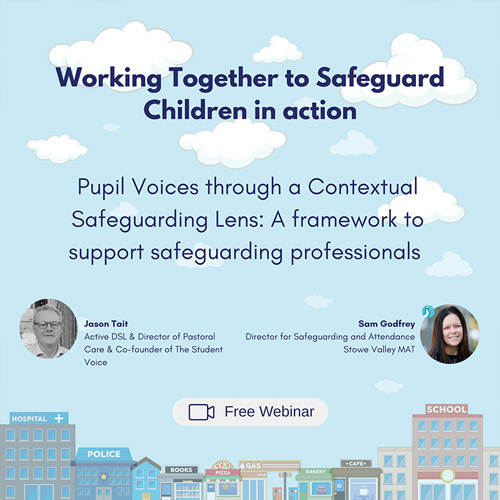
Webinar – Working Together to Safeguard Children in action with Sam Godfrey
Free Workshop Pupil Voices through a Contextual [...]
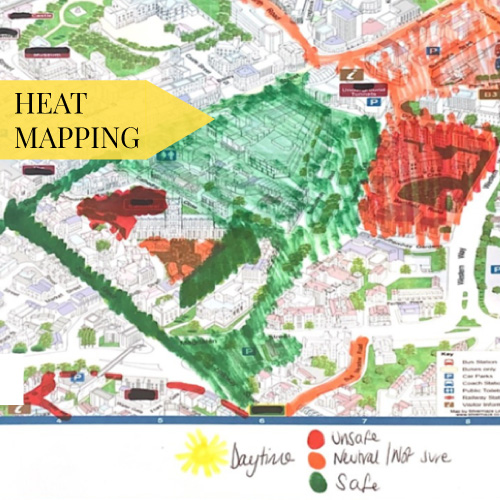
Heat Mapping & RAG Rating – Contextual Safeguarding
Heat Mapping & RAG Rating - Contextual Safeguarding in [...]
Safeguarding Webinar: ‘Contextual Safeguarding, Extra-Familial Harm and the role of pupil voice’
Contextual Safeguarding Webinar 'Contextual Safeguarding, Extra-Familial Harm [...]
Safeguarding Webinar: School Culture, Information Sharing and Contextual Safeguarding
School Culture, Information Sharing and Contextual Safeguarding Webinar [...]
NSPCC Safeguarding Training | Contextual Safeguarding
NSPCC Safeguarding Training, Contextual Safeguarding and The Student Voice [...]

Contextual Safeguarding Workshop Snippet (6 mins)
Contextual Safeguarding Workshop: The Key to Safer Communities [...]
