Building Protective Capacity® in Schools and Communities


Swipe the Carousel
Building Protective Capacity® in Schools and Communities
Safeguarding children and young people has never been more complex. Schools and safeguarding professionals face the daily challenge of limited time and resources, while also navigating an ever-growing list of harms identified in statutory guidance like Keeping Children Safe in Education (KCSIE).
In this context, one concept is becoming increasingly important: protective capacity®.
What Do We Mean by Protective Capacity?
Protective capacity is the collaborative, relational power of schools, social care, police, health partners, communities, and most importantly, young people themselves, Working Together to Safeguard Children.
Think of it this way:
On your own, as one school or organisation, your protective capacity is “1.”
But when that school shares a common language (the voice of the child) and operates within a shared framework (contextual safeguarding), its capacity multiplies. Add in:
Other schools in the area
➕Early help support services
➕Children’s social care
➕Health partners
➕The police
…suddenly the capacity to protect children grows dramatically.
Why Protective Capacity Matters
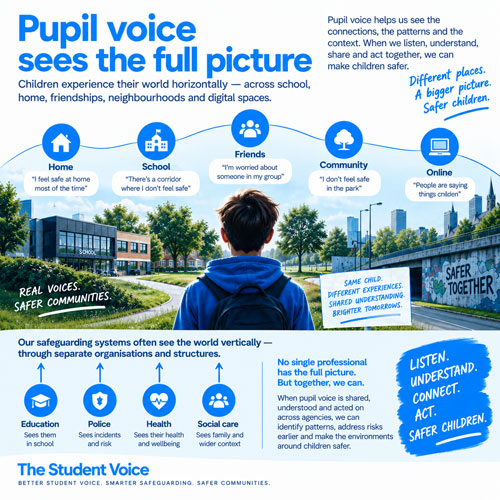
When schools and safeguarding agencies operate in silos, the burden falls on individual professionals, who may feel isolated and overstretched. This can lead to missed opportunities for early intervention and a fragmented picture of a young person’s needs.
Protective capacity shifts the focus to collective responsibility. By working together:
- Agencies develop a shared understanding of the risks and concerns facing young people.
- Professionals gain a clearer sense of context, not just what happens inside the school gates, but in the wider community.
- Support becomes targeted and timely, rather than reactive and inconsistent.
The Role of the Voice of the Child
At the heart of protective capacity is the voice of the child.
When children and young people are genuinely heard:
- Safeguarding priorities reflect their lived experiences, not just adult assumptions.
- Interventions are more relevant, meaningful, and effective.
- Agencies gain a common language to collaborate around, keeping the child’s perspective central.
This common language ensures that whether you are a teacher, social worker, health visitor, or police officer, you are all working from the same starting point.
Protective Capacity in Action
Imagine a school dealing with concerns around peer-on-peer exploitation. Alone, the school might implement a behaviour policy or raise awareness through assemblies.
But when working within a protective capacity framework:
- Other local schools share patterns they are seeing.
- Police and social care provide context on wider community concerns.
- Health services highlight related issues affecting wellbeing.
- Young people themselves share insights into what’s really happening.
Together, this builds a fuller picture, enabling interventions that are both school-specific and community-wide.
Moving Forward
Building protective capacity requires commitment from all safeguarding partners. It asks us to:
- Move beyond compliance and tick-box exercises.
- Invest in building common language and frameworks.
- Put the voice of the child at the centre of decision-making.
When we do this, safeguarding becomes not just an individual responsibility, but a shared endeavour, one that dramatically increases our ability to protect and support young people.