If pupil voice is going to make children safer, it has to travel further
We have spent years encouraging children to speak. I think the question for safeguarding now is whether the systems around them are good enough at listening together.
I have spent a lot of my professional life thinking about how we help children tell us when something is not right. We create trusted adults, run surveys, build reporting routes and ask students where they feel safe, who they would go to and what worries them. All of that matters.
But I have become increasingly convinced that there is a point at which ‘pupil voice’ can become too comfortable a phrase. Hearing a child is not the same as understanding what children are telling us collectively, and listening is not the same as changing something.
A disclosure might tell us what happened to one child. Five apparently unrelated comments might tell us something about a corridor, a bus stop, a peer group, an online space or a part of the community. The challenge is that those five pieces of information do not always arrive in the same place, at the same time or with the same professional.
For me, that is where pupil voice starts to become safeguarding intelligence.
The data made me stop and think
We recently asked 100 safeguarding professionals to assess how they use pupil voice in practice. Some of the findings were very encouraging. Among the DSLs who responded, 98% were using pupil concerns to improve safeguarding culture, 91% showed strong practice in helping pupils feel safe expressing themselves, and 89% demonstrated strong practice around inclusive participation.
So I do not think the problem is that schools are not listening. What caught my attention was what happened after the listening. 40% were not yet systematically identifying safeguarding hotspots. 45% were not consistently sharing anonymised pupil insight with external partners, while 59% were not regularly bringing authentic pupil voice into police or safer-school partnerships. Those figures made me wonder whether we have built better ways for children to speak than we have built ways for organisations to hear them together.
Everybody can hold a piece of the picture
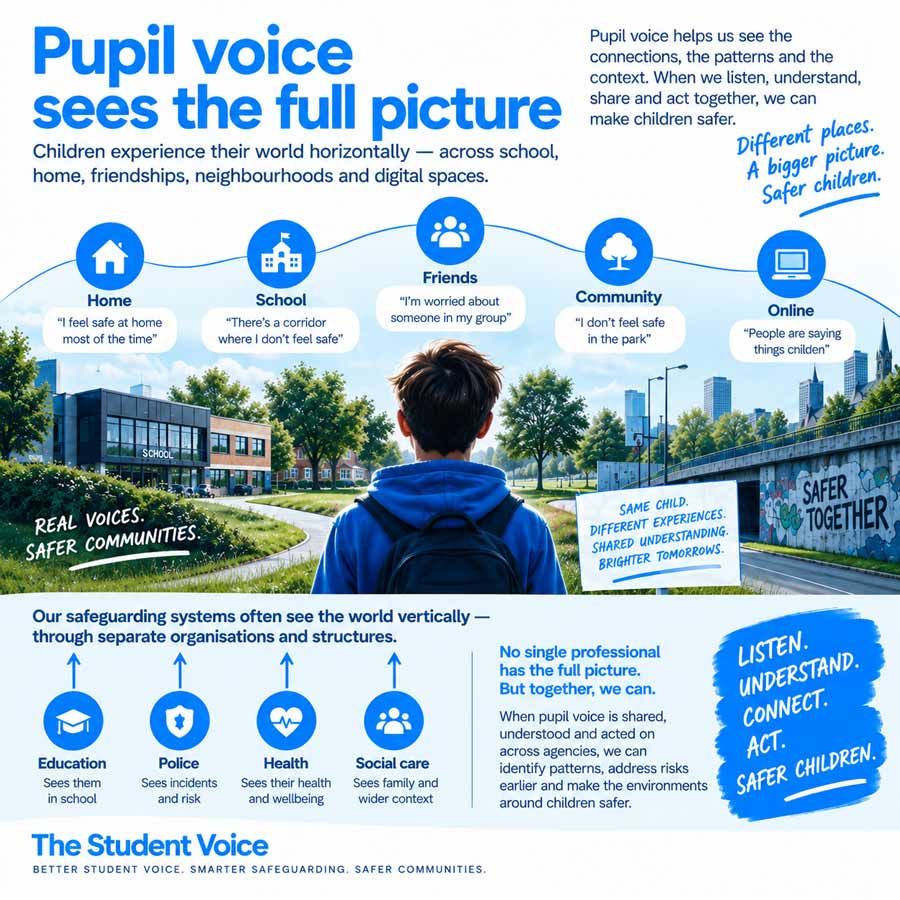
Anyone who has worked in safeguarding will recognise this challenge. A school may know that pupils are talking about a particular location, while police are seeing incidents nearby. Another school may be hearing something similar. Social care may understand the family or peer-group context, while colleagues in health may hold another important piece of information.
Nobody is necessarily missing the concern. The problem is that nobody necessarily has the whole picture.
Working Together to Safeguard Children 2026 says this plainly: no single practitioner can have a full picture of a child’s needs and circumstances. It expects professionals to share information and bring together children’s voices, practitioner knowledge and data.
In principle, few safeguarding professionals would disagree. In practice, it is difficult. Our systems are different, our thresholds are different and we use different language. We worry, rightly, about confidentiality and proportionality. Professionals can be unsure about what they can share, when they can share it and with whom. Information can also move between services stripped of the context that made it meaningful in the first place.
There is another challenge too. Safeguarding systems are understandably very good at thinking about individual children. They can be less good at recognising what a collection of individual experiences is telling us about the context around those children.
What if the pattern is the safeguarding concern?
This is one of the questions I want us to wrestle with this year. Imagine that no individual disclosure reaches a threshold that immediately changes the picture. Over several weeks, however, different pupils describe feeling unsafe in the same place. Perhaps students across two schools begin talking about the same peer group, or a pattern starts to appear around a journey home, a local park or an online space.
At what point does the pattern itself become important safeguarding information?
That does not mean passing children’s identifiable comments around agencies. It means having the early insight to better recognise themes, anonymise insight where appropriate, understanding context and asking who else might hold another part of the picture.
The DfE’s information-sharing guidance is clear that data protection law should not stand in the way of justified safeguarding information sharing. Information still needs to be shared for the right purpose, with the right people, and in a way that is necessary, proportionate, relevant, accurate, timely and secure.
The new information-sharing duty planned from September 2026 makes this conversation even more timely. But legislation alone will not solve the problem. A duty can tell us that information should move; it cannot, by itself, make that information meaningful.
So what are we going to do about it?
At The Student Voice, we are going to spend this year exploring that question with the safeguarding community. We are not suggesting that pupil voice fixes safeguarding, because it doesn’t. Nor do I think another dashboard, survey or reporting tool is the answer on its own.
Instead, I want us to get much more practical about the journey from a child’s experience to safeguarding action. Can every child speak, and who are we still not hearing? What do individual reports tell us when we look at them together? Who outside our organisation might need to understand the pattern? And, after we act, how do we know whether children actually feel safer?
We will share our findings, but I want us to spend more time on the difficult questions behind the percentages. We will talk to practitioners, share case studies and explore what happens when student insight reaches a multi-agency meeting, when a hotspot becomes visible or when two organisations realise they are seeing different parts of the same picture. Just as importantly, we will look at what happens when schools go back to children and ask: did what we changed actually work?
Children see things our systems do not
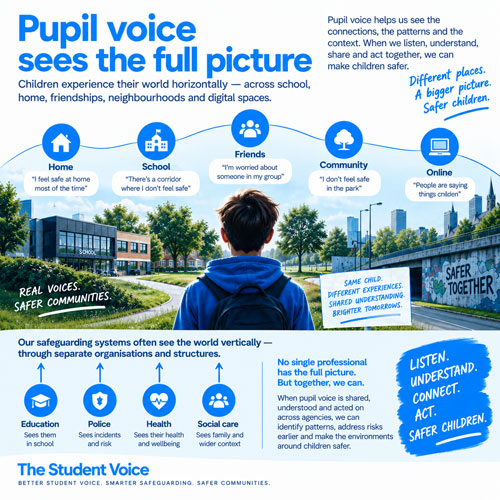
This is probably the simplest way I can explain why this matters to me. Children experience their world horizontally. They move through school, home, friendships, neighbourhoods and digital spaces without thinking about which agency is responsible for which part. Our safeguarding systems, by contrast, tend to experience that same child vertically: through education, police, health and social care.
Pupil voice can help us see across those boundaries, but only if we do something meaningful with what children tell us.
So this year, I want to move the conversation beyond whether we listen to children. I want us to ask whether we are curious enough about what they tell us, whether we connect it with what others know and whether we can show children that their voice changed something.
Ultimately, the measure of good pupil voice is not how many children we asked. It is whether understanding their world helped us make it safer.
Four questions will guide our work
Provide brave spaces
Can every child speak, and do we know where they feel unsafe?
Creating routes for students to speak is only the beginning. We will explore accessible and confidential reporting, participation gaps, barriers to disclosure and safeguarding hotspots. Low scoring around systematic hotspot identification gives this work particular urgency. We need to ask not only whether pupils can speak, but who may still be missing and what locations, times or contexts their experiences reveal.
Seek to understand pupil voice
What are pupils really telling us?
One report can tell us something important about one child’s experience. Multiple reports may tell us something about the environment around children. We will explore how safeguarding teams can move from incident to theme, from theme to pattern and from pattern to contextual safeguarding intelligence, building on the strong finding that 98% of DSL respondents already use pupil concerns to improve safeguarding culture.
Partner with our community
Who else needs to know, and act?
This is where we identified some of the largest gaps. 45% of DSL respondents were not consistently sharing anonymised pupil insight with external partners, while 59% were not regularly bringing authentic pupil voice into police or safer-school partnerships.
We want to explore what meaningful partnership looks like in practice: authentic pupil voice rather than adult interpretation, appropriate anonymisation, multi-agency meetings, community hotspot mapping and cross-school patterns. The practical question is simple: if children are telling us something important about risk in their community, who else needs to hear it?
Measure outcomes
What changed because pupils spoke?
Closing the loop should be more than a ‘You Said, We Did’ poster. I think we need to see it as part of safeguarding trust and accountability. Did the intervention work? Do pupils actually feel safer? Did the hotspot change? Did participation increase? What evidence can we share with leaders, governors and safeguarding partners?
With 28% scoring low on action and outcome tracking, this is an important final part of the journey. If we ask children to trust us with their experiences, we should also be prepared to inform and ask whether our intervention made a difference.
What you can expect from us this year
Across the 2026/27 academic year, these four questions will structure our work with the safeguarding community. We will draw on our findings, practitioner voices, school case studies, research and practical tools, moving from how children are heard and understood, through partnership and multi-agency safeguarding, to how we measure whether action has made a difference.
Every piece we produce should give a busy safeguarding professional something useful: an insight worth thinking about, a question worth asking, an action worth trying or evidence worth sharing.
An invitation to the safeguarding community
Perhaps the most important thing our findings told us is that schools are already listening. That is the foundation. The opportunity now is to become increasingly curious about what happens next.
When one child tells us something, we listen. When many children tell us similar things, we need to ask what the pattern means. Where is this happening? Who is experiencing it? Who are we not hearing from? What might be happening beyond our gates? Who else needs to know? And, crucially, what changed because we acted?
These are the questions we want to explore with you this year.
Because the goal is not simply more pupil voice. It is better safeguarding because of pupil voice.

Author Bio – Jason, Director of Pastoral Care & DSL at TASIS and Co-Founder of The Student Voice
In addition to pastoral care and safeguarding across his school, Jason helps schools leverage student input to drive systemic change. He combines expertise in child-centered design, social justice, and digital innovation. Jason is also co-founder of award-winning platform The Student Voice.
The Student Voice supports organisations to strengthen their approach to safeguarding young people through contextual safeguarding, youth participation and shared language. Focusing on helping professionals better understand young people’s lived experiences and building protective capacity across communities.