What does active pupil voice look like in practice? 10,000+ insights at Wrenn Secondary School
Vice Principal & DSL at Wrenn School, part of Creative Education Trust
About this case study
What does active pupil voice look like in practice?
From pupil voice to safeguarding action
Hear from Vice Principal, Rebecca Hales, at Wrenn School in Northamptonshire. Rebecca shared how the school has embedded effective pupil voice into everyday safeguarding, giving pupils meaningful opportunities to be heard and turning their insight into action.
Wrenn Secondary School is a mixed state academy of around 1,500 students. For Rebecca, successful pupil voice starts with a simple principle: if you want young people to engage, you have to make space for it, and they need to know something will happen as a result. Rather than relying on pupils to engage with student voice activities in their own time, Wrenn has built participation into the school day. Twice a year, students across Key Stages 3 and 4 are given dedicated time to map and RAG rate areas of their school according to how safe they feel.
Rebecca introduces the exercise personally, explaining why honest responses matter and, crucially, what the school will do with them.
“I want them to tell me the truth. I have to explain to them that what you tell me, I’m going to do something with it.”
10,000+ insights. One much clearer picture.
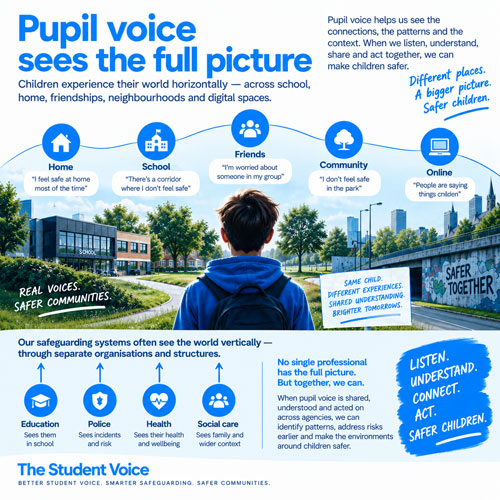
Wrenn collected more than 10,000 individual pieces of student insight across the last 3 years. That scale transforms pupil voice from anecdotal feedback into actionable safeguarding intelligence. The school can identify where pupils feel safe or unsafe, compare results over time and see patterns that might otherwise remain hidden. In Rebecca’s example, the proportion of responses identifying areas as unsafe had fallen by four percentage points since the previous exercise.
But collecting the data is only the beginning. The findings influence staff duty rotas, staff training and safeguarding priorities. They are also taken back to pupils in assemblies, where students can see what their collective feedback has revealed and become part of the conversation about what happens next. The feedback loop matters. Pupils are not being asked for their views simply to satisfy a consultation exercise. They can see that their experiences are shaping decisions.

Making it easier to ask for help
Wrenn has applied the same principle to individual support. Rebecca wanted to remove the requirement for a student experiencing difficulties with their mental health to first approach an adult face to face. She recognised that having to start that conversation could itself be a significant barrier, particularly for some boys. Working with The Student Voice, Wrenn developed its Seek Support pathway so pupils can privately request the type of support they feel most comfortable accessing.
Students can choose from options including peer mentoring, one to one pastoral support, counselling and dog therapy. Rebecca shared the example of one boy who used the platform to explain that he no longer felt like himself and simply wanted someone to listen. Rather than having to initiate that conversation in person, he was able to express what he was experiencing and choose dog therapy as the support he wanted. The technology did not replace the school’s safeguarding relationships. It created another route into them.
What successful pupil voice engagement looks like
Wrenn’s experience demonstrates that active pupil voice works when schools:
- Create the opportunity to participate: Engagement is deliberately built into curriculum and tutor time rather than left to chance.
- Explain why pupils’ voices matter: Students understand that honest feedback helps the school make better decisions.
- Close the feedback loop: Findings are taken back to pupils and the school demonstrates what has changed.
- Turn insight into action: Student experience informs safeguarding deployment, training and intervention.
- Remove barriers to seeking support: Pupils can communicate in ways that feel manageable to them and have greater agency over the support they receive.
From listening to action
The result is pupil voice that is active rather than passive. Students are not simply being asked what they think. Their experiences are helping Wrenn understand risk, identify concerns earlier, improve safeguarding and make better informed decisions. With more than 10,000 individual insights captured through pupil mapping, Wrenn is building a richer picture of student experience and using it to shape safeguarding in real time. This is what meaningful pupil voice looks like: creating the opportunity to be heard, building trust through action, and making student insight part of how a school understands and supports its pupils.
What school, MAT and Local Authority decision makers say
Familial harm, RAG rating & centralising pupil voice
Safeguarding Director, Creative Education Trust, 17 Schools
How school tackles harm in the community
DSL, Kineton High School, part of Stowe Valley Multi Academy Trust
An update on The Voice Project | 1 Year in
The London Borough of Havering
Local Authority Champion Young Voices | The Voice Project
Trevor Cook, The London Borough Of Havering, 20+ schools
Identifying community hotspots where children feel unsafe
Jon Barnett, Warwick District Council
Proactively working with the Police
Rugby Free Secondary, Assistant Headteacher and DSL
Good governance and centralising data to identify patterns and trends
Stowe Valley MAT, 11 schools.
Student advocacy and engaging pupil voice
Haberdashers’ Monmouth School, Acting Head
Ensuring students feel heard, safe and listened to
Millfield School, Deputy Head (Pastoral)