What 100 safeguarding professionals said about pupil voice, contextual safeguarding & multi-agency working

How does your student voice practice compare?
100 Safeguarding professionals have reflected on how they capture, understand and act on pupil voice. We’ve brought the anonymised responses together to explore where practice appears strongest, where common challenges are emerging and what safeguarding professionals could consider next.
The results tell an encouraging story. Many settings appear to have established ways for students to speak, are thinking about inclusive participation and are using pupil feedback to inform improvement.
But the results also reveal something interesting. The biggest opportunities appear further along the student voice journey.
The question is becoming less about whether we are listening to students and more about how effectively we turn what students tell us into safeguarding intelligence, action and impact.
Where are the biggest opportunities? Three areas stood out.
Bringing student voice into multi agency safeguarding
59% of DSL respondents identified bringing authentic student voice into police panels or safer school partnerships as an area to develop.
If this is something your setting is still developing, you’re clearly not alone.
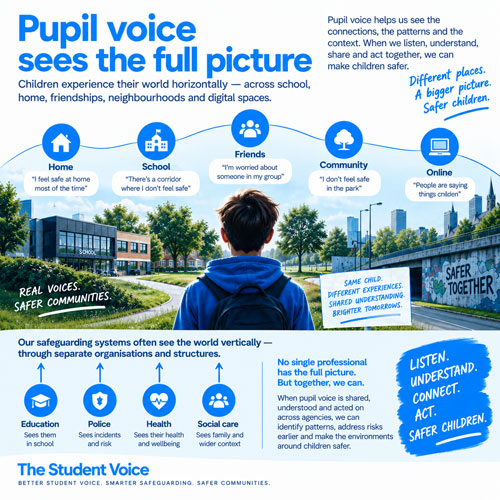
Schools can hold incredibly valuable insight into what young people are experiencing beyond the school gates. This might include locations where they feel unsafe, concerns around transport, peer relationships, exploitation or other contextual risks.
The opportunity is to consider how appropriate, anonymised student insight can become part of wider safeguarding conversations. The results highlight that involving student insight in partnership discussions can help ensure interventions are grounded in young people’s actual experiences and needs.
For settings already doing this well, the next step could be considering how regularly pupil insight is represented and whether students themselves would recognise the picture being presented by adults.
Sharing pupil insight with external partners
45% of DSL respondents identified an opportunity to strengthen how they share anonymised student feedback with external partners.
This finding is closely connected to the first. A school may already be listening effectively to its students, but how easily can the themes emerging from those conversations be turned into useful, anonymised intelligence for Local Authorities, police, youth services and other safeguarding partners?
This does not mean sharing every piece of feedback. It means identifying the insight that could help professionals see a bigger picture, such as common themes, locations, emerging concerns or changes in young people’s experiences.
This suggests moving towards structured sharing of anonymised themes relevant to areas such as public safety, transport and local spaces.
For settings already sharing insight, the next opportunity might be to consider whether this happens consistently rather than only when an issue arises, and whether insight could be connected across different schools or communities.
Moving from individual concerns to the bigger picture
40% of DSL respondents were managing concerns case by case without systematically identifying where safeguarding concerns are concentrated.
Responding effectively to an individual concern will always be fundamental to safeguarding. But student voice can potentially tell us something more when individual experiences are considered together.
Imagine several students independently identifying the same park, corridor, bus route or area of the community as somewhere they feel unsafe. Individually, those responses are important. Together, they may reveal a pattern.
The results highlight hotspot mapping as a way of identifying where risks cluster, while case by case handling can make systemic risks and repeat incidents more difficult to see.
For settings already identifying hotspots, the next step could be comparing locations with factors such as time, year group, concern type or changes over time.
Where is practice already strongest?
It is equally important to recognise what safeguarding professionals are excelling.
70% are doing well at creating routes for students to speak. Many respondents reported having structured or accessible ways for students to raise concerns. That is a strong foundation to build upon. The next question could be whether all students are equally able and willing to use those routes, and whether there are groups whose voices are heard less frequently.
65% are doing well around inclusive participation. Many respondents are already taking steps to make student voice accessible and inclusive. For settings doing this well, the next stage could be analysing participation rather than simply providing access. Are particular groups underrepresented? Are quieter or more vulnerable students participating? Do different students need different ways to contribute?
The survey itself recommends monitoring participation and identifying who is not represented so that barriers can be understood and addressed.
62% are doing well at using student voice to inform improvement. This is another encouraging finding. For settings with more mature practice, the opportunity is to go beyond being able to say that something changed because students spoke. The next step is being able to demonstrate what changed, why it changed and whether it worked.
This could involve linking pupil insight to actions, tracking outcomes and returning to students to understand whether an intervention actually improved their experience.
From student voice to safer outcomes
Perhaps the clearest message is that collecting pupil voice is only one part of the process.
It begins with listening, by giving students safe and accessible opportunities to tell us what they are experiencing. The next stage is capturing and understanding that information so that it does not remain in disconnected conversations, surveys or reports.
From there, schools can begin to identify themes, patterns, changes and hotspots. Those insights can then inform action, supporting safeguarding decisions and interventions. Where appropriate, relevant anonymised intelligence can also be shared with safeguarding partners to contribute to a wider understanding of young people’s experiences.
Finally, there is the importance of closing the loop. Students should be able to see that speaking up can lead to meaningful action. Regularly responding to student feedback can demonstrate that students have been heard, build trust and encourage continued engagement with pupil voice and reporting systems. Each stage strengthening the next. The aim is not simply to collect more pupil voice, but to make the voice we are already hearing more meaningful and actionable.
So, where would your setting sit?
These findings are not intended to provide a judgement on individual schools or safeguarding professionals. Instead, they provide an emerging benchmark, giving safeguarding professionals an opportunity to see which challenges others are encountering, recognise where their own practice may already be strong and consider what their next step could be.
Your setting might already have excellent reporting routes but want to understand participation better. You might be gathering significant amounts of pupil insight but want to become better at identifying patterns. Or you might already have sophisticated internal practice and be considering how pupil intelligence can contribute to wider multi agency safeguarding.
Wherever you are starting from, the goal is not simply to collect more student voice. It is to make the voice you are already hearing as meaningful and actionable as possible.
How does your practice compare?
Take our free Student Voice Assessment to reflect on your current approach, identify where you are already doing well and discover practical opportunities to take your student voice practice further.